
What Fills the Cup

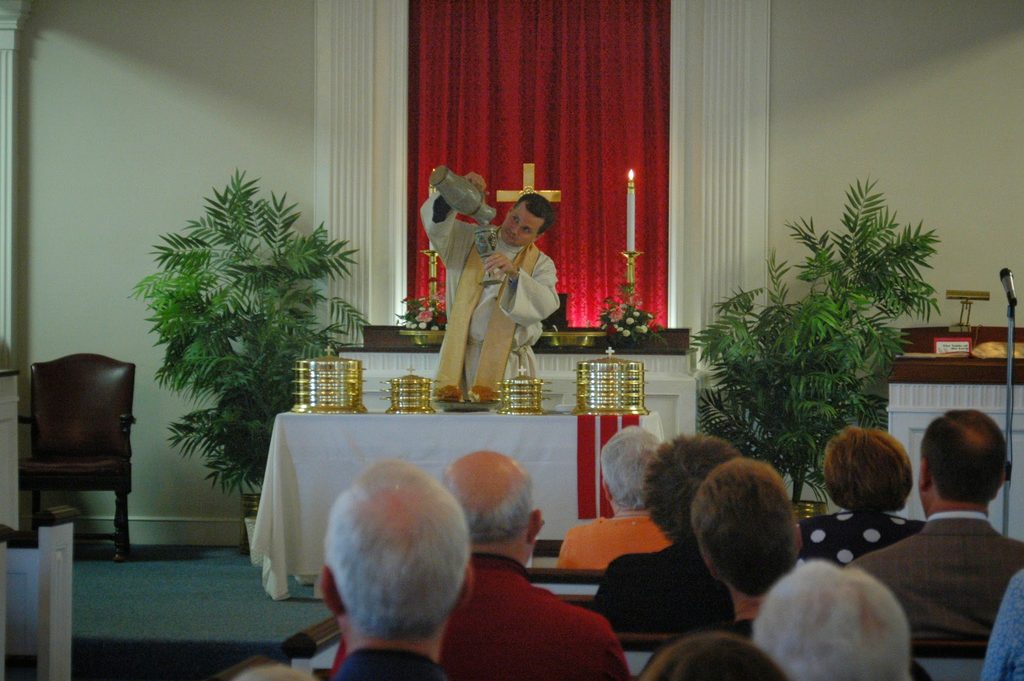
Twenty years ago, in September 2006, I stood behind the Communion table at Community Protestant Church for the first time as the congregation’s newly called pastor. In the photograph, the sanctuary looks both familiar and distant. The red curtain hangs behind the cross. The table is set with trays, bread, chalice, and flagon. Members of the congregation sit in the pews, watching as their new pastor leads them in a sacrament they had celebrated together countless times before.
Everything appears solemn and orderly.
The photograph, however, captured the precise moment when I discovered that things were not quite as orderly as they appeared.
I lifted the flagon, expecting it to contain enough grape juice for a ceremonial pouring into the chalice. I tilted it, and then…nothing. Dry as a bone.
Dave Kublank caught this shot of me looking up into the flagon’s empty interior while my mind undoubtedly raced through a number of suitable ways to proceed. If memory serves, I opened one of the trays holding the individual cups, removed a cup, and poured its thimbleful of grape juice into the Communion chalice.
It was my first time administering Communion at CPC, and clearly the Deacons and I had arrived at that place and time with different assumptions about “the way” Communion was supposed to unfold. I assumed that the flagon would be filled because I intended to pour from it. The Deacons, understandably, had prepared Communion according to the congregation’s familiar practice. No one had thought to discuss the contents of the flagon beforehand because each of us assumed that everyone else understood what was supposed to happen.
Despite a few seconds of confusion and some quick improvisation, we continued. The bread was broken. The cup was shared. Christ’s invitation was extended. All of us were fed at Christ’s table that morning.
Twenty years later, after presiding at Communion here at least two hundred times, I understand that moment differently. I still believe that the vessels matter, that the words and actions matter, and that careful preparation matters. But I am much less concerned with the mechanics of Communion than I am with what all those actions, performed correctly or imperfectly, are intended to proclaim: the relentless and unconditional welcome of Christ, our host.
That first Communion also taught me something about the relationship between a pastor and a congregation. Both arrive with assumptions. Both carry traditions, habits, expectations, and ideas about how things are supposed to be done. Over time, pastor and congregation learn one another’s ways. They discover what should be preserved, what can be changed, what needs to be discussed, and what simply requires a little grace and a willingness to adapt.
CPC and I have spent twenty years learning those things together.
During that time, we have shared far more than bread and cup. We have shared baptisms, weddings, memorial services, Confirmation vows, Christmas Eve candles, Easter celebrations, potluck meals, difficult decisions, unexpected challenges, and more board meetings than any of us could count. We have welcomed new people and said goodbye to people we dearly loved. We have laughed together, grieved together, served together, disagreed at times, and continued seeking Christ together.
We have not always arrived with identical assumptions. We have not always known exactly what to do next. We have not performed every part perfectly. Still, Christ has met us here.
The empty flagon has become a fitting image for another lesson these years have taught me. Ministry includes moments when our plans, expectations, and personal reserves seem insufficient. Pastors sometimes stand before a congregation expected to offer the right words when no words seem adequate. Congregations face needs larger than their resources and questions without obvious answers. There are seasons when we lift the vessel expecting it to be full, only to discover that it is not.
Yet the life we have shared at CPC has reminded me that the church does not depend upon any one vessel being full. It does not depend upon the pastor having every answer, the congregation possessing unlimited resources, or our plans unfolding without interruption. What fills the cup is the grace of Christ, made visible through the prayers, generosity, forgiveness, humor, service, and faithfulness of a community gathered around the table.
That seems especially important as we prepare to celebrate World Communion Sunday this week.
On World Communion Sunday, Christians in countless places, speaking different languages and following different customs, will gather around Christ’s table. The vessels will not all look alike. The bread will not all taste alike. The words, music, and movements will differ. Even our understandings of what happens at the table will not be identical.
Nevertheless, Christ will be the host.
World Communion Sunday reminds us that the table does not belong to one congregation, denomination, nation, culture, or pastor. We come with different histories and customs, different assumptions about “the way” Communion should unfold, and different amounts to place upon the table. Yet Christ gathers us into one body and offers grace that is not limited by the size of our vessels or the perfection of our practices.
Twenty years ago, the flagon was empty, the chalice received only a thimbleful, and Communion continued. The photograph still makes me smile. It also reminds me that Christ has never required our plans to be flawless before welcoming and feeding us.
After twenty years, I remain grateful to stand behind this table. I am even more grateful that I do not stand there only to preside. Like everyone else, I come to receive. The vessels may sometimes be empty. Our own reserves may sometimes run low. But Christ’s welcome remains abundant, and grace continues to fill the cup.